
Engineering
Ventilation
A ventilation system that runs at full throttle around the clock is not modern. It is expensive. We plan it differently – with heat recovery, CO₂-based airflow control and BMS integration to DIN EN 16798 and VDI 6022.
What we deliver
High heat-recovery efficiency*
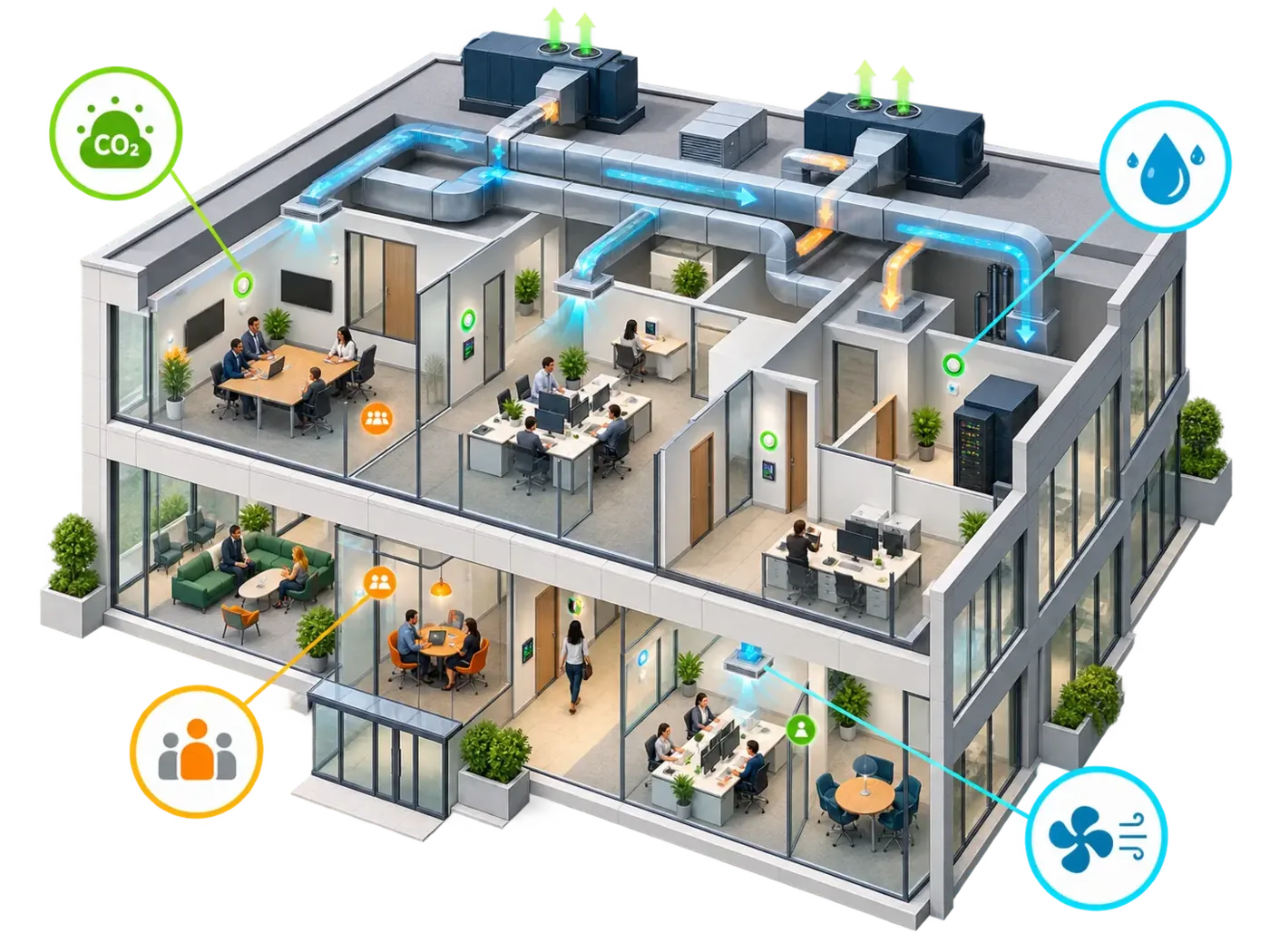
Heat recovery via rotary or plate heat exchangers transfers the energy of the exhaust air directly to the outdoor air.
CO₂ demand control
Sensors automatically adapt the airflow to the actual room occupancy – room by room.
ErP & GEG compliant
Designed to Regulation (EU) 1253/2014, DIN EN 16798 and the German Building Energy Act – cleanly documented.
BACnet & Modbus
Full integration of fans, damper actuators and VAV controllers into the higher-level building automation.
Typical scope
- We calculate your airflow to DIN EN 16798 room by room
- We choose rotary or plate heat exchanger according to hygiene requirements
- We integrate into the existing BMS – across manufacturers
- We check funding eligibility
- Filter changes by differential pressure instead of by calendar – documented to VDI 6022
Frequently asked questions
Practical questions from our consulting – answered honestly
What does the European Ecodesign Directive (ErP) require for commercial ventilation systems?
Regulation (EU) 1253/2014 makes a heat-recovery system mandatory for non-residential ventilation units from an airflow of 250 m³/h. In addition, minimum requirements apply to efficiency and specific fan power (SFP). Fans must be equipped with speed-controlled drives such as EC motors or frequency converters.
Which standard governs the design of central ventilation systems for non-residential buildings today?
The decisive standard is the DIN EN 16798 series, in particular DIN EN 16798-3 for non-residential buildings. It regulates requirements for design, air-quality categories and the energy performance of ventilation systems. The hygiene requirements of VDI 6022 and the Ecodesign Regulation (EU) 1253/2014 apply in addition.
How often do the air filters in an air-handling unit need to be replaced?
Instead of fixed calendar intervals, the control concept monitors the static differential pressure across the filter bed. When the filter reaches the defined limit (e.g. 150 Pa), the BMS reports a maintenance request. This maximises filter service life and measurably reduces material costs. The hygiene inspection is carried out additionally in accordance with VDI 6022.
Can an existing air-handling unit be retrofitted into an existing BMS?
Yes. Via open protocols such as BACnet/IP, Modbus TCP or KNX, older air-handling units can be connected vendor-independently to a higher-level building management system. Often replacing the controller or installing a gateway is enough. Free-cooling logic, time programmes and filter monitoring can then be implemented without a complete unit replacement.
* Ranges for COP values, efficiencies and savings are empirical values from comparable reference plants and not a guarantee for a specific property. We only make binding statements after an on-site analysis, load-profile recording and a property-specific calculation to VDI 2067. Manufacturer and component names are deliberately not mentioned – selection is made per project and vendor-neutrally.
Powered by the platform
Plan your project with us.
We typically reply within one business day.