
Engineering
Heat Pumps
From the small café to the industrial plant: we plan heat-pump systems that still run economically in their fifth winter. With heat-load calculation to DIN EN 12831, control programming by our own hand and an honest assessment of the existing building instead of marketing promises.

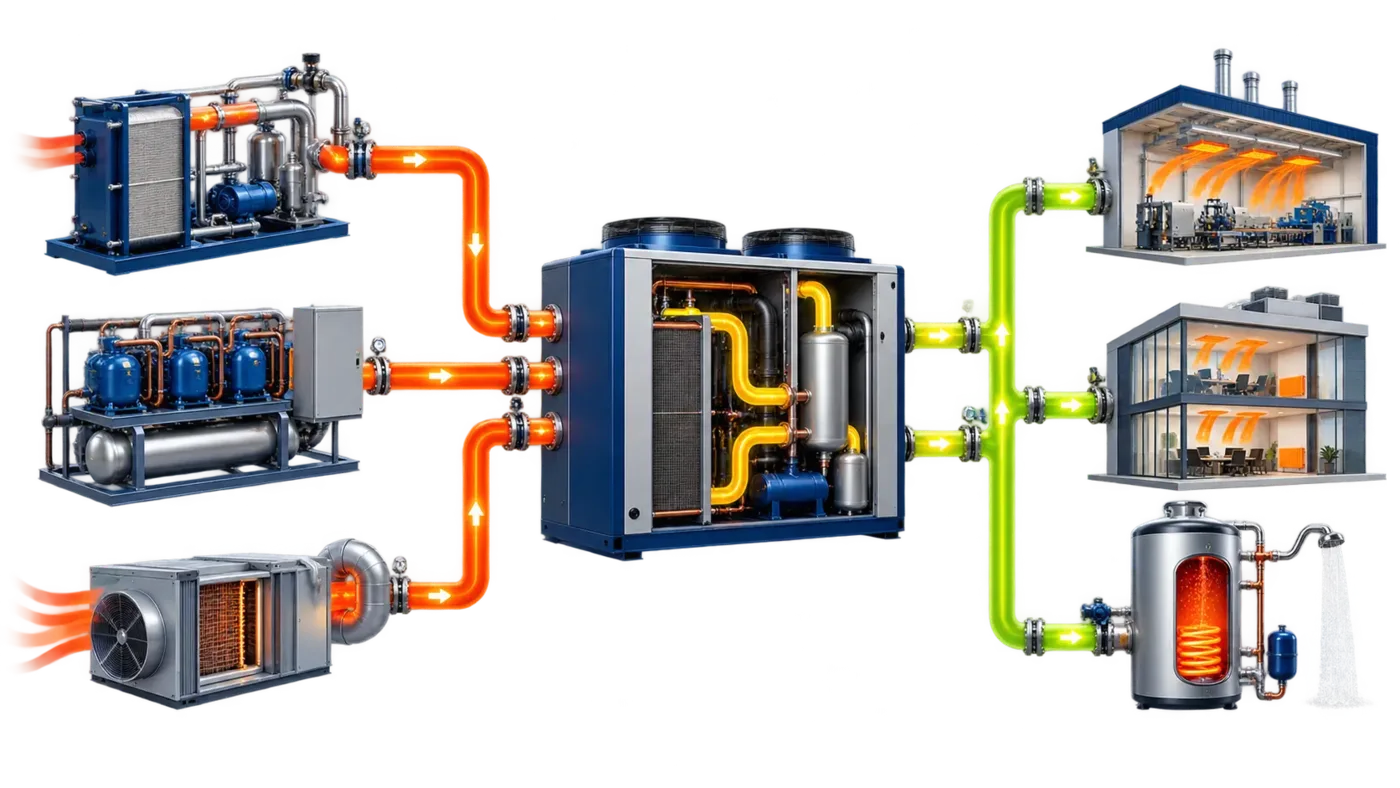
What we deliver
System instead of unit
Heat source, heating surface, hydraulics, control and sensors as an orchestrated whole.
Our own control programming
Bivalence point, cascade, defrost, heating curve on the three major DDC platforms.
PV coupling
Buffer tank full between 11 am and 3 pm – self-consumption optimisation via Modbus or BACnet.
Honest advice
If the conditions are unsuitable, we say so openly – instead of selling a poorly matched system.
Typical scope
- We calculate the heating load to DIN EN 12831 and size the heat pump to VDI 4645
- We select the heat pump vendor-neutrally – what fits the property, not a supplier's product range
- We program the control logic ourselves on the three major DDC platforms
- We integrate the PV system into the BMS via Modbus or BACnet – self-consumption optimisation with buffer pre-charging
- We check funding eligibility for individual measures and prepare the technical evidence
Frequently asked questions
Practical questions from our consulting – answered honestly
For which commercial properties do you plan heat-pump systems?
We plan vendor-independently for the whole range of commercial applications – from the small café or hairdresser with a compact unit to the industrial site with cascades in the upper output range. Classic fields are office buildings and administrations, hotels and guesthouses, schools and educational institutions, care facilities, medical practices, retail spaces, workshops, production sites with process-heat demand, logistics halls and data centres. Sizing is done per project according to heating load, usage profile and economic analysis.
Which heat-pump manufacturers do you install?
We plan vendor-neutrally. Depending on sizing and supply situation, heat pumps from various market participants in the commercial segment are used. The specific selection is made per project according to heat source, output range, refrigerant, seasonal performance requirement and economics. There is no contractual tie to a single heat-pump manufacturer – this protects against a vendor cage and gives us room to negotiate purchase prices.
Do you also install photovoltaic systems?
No, we do not install photovoltaic systems. What we provide is the control integration of an existing PV system, or one built by a third party, with the heat pump and the BMS. We connect the PV system to the BMS via its Modbus or BACnet interface and use the generation phases for targeted buffer-tank pre-charging – typically in the midday hours between 11 am and 3 pm. This way PV electricity is used for heating energy instead of flowing into the grid. The strategy depends on the property: the size of the PV storage, the load profile after sunset and the buffer volume determine how aggressively pre-charging can be run.
What sets JuKo Tech apart from other heat-pump providers?
Three points are noticeable in practice. First: our own programming competence – we are Siemens Solution Partner and certified Schneider Electric partner and program the control logic ourselves instead of outsourcing it. Second: vendor-neutral component selection without a contractual cage. We install the heat pump that fits the project – not the one that brings us the highest margin. Third: an honest preliminary check. If the conditions are unsuitable (for example an unrenovated envelope with old radiators), we say so openly instead of selling a poorly matched system.
* Ranges for COP values, efficiencies and savings are empirical values from comparable reference plants and not a guarantee for a specific property. A reliable forecast is only possible after property-specific sizing to VDI 4645 and seasonal-performance (JAZ) calculation to VDI 4650. Manufacturer and component names are deliberately not mentioned – selection is made per project and vendor-neutrally.
Powered by the platform
Plan your project with us.
We typically reply within one business day.